
George was a totally normal 18-month-old baby, reaching all the milestones he should, getting up to mischief and filling the room with smiles and love, but at the end of April 2023, things started to change.
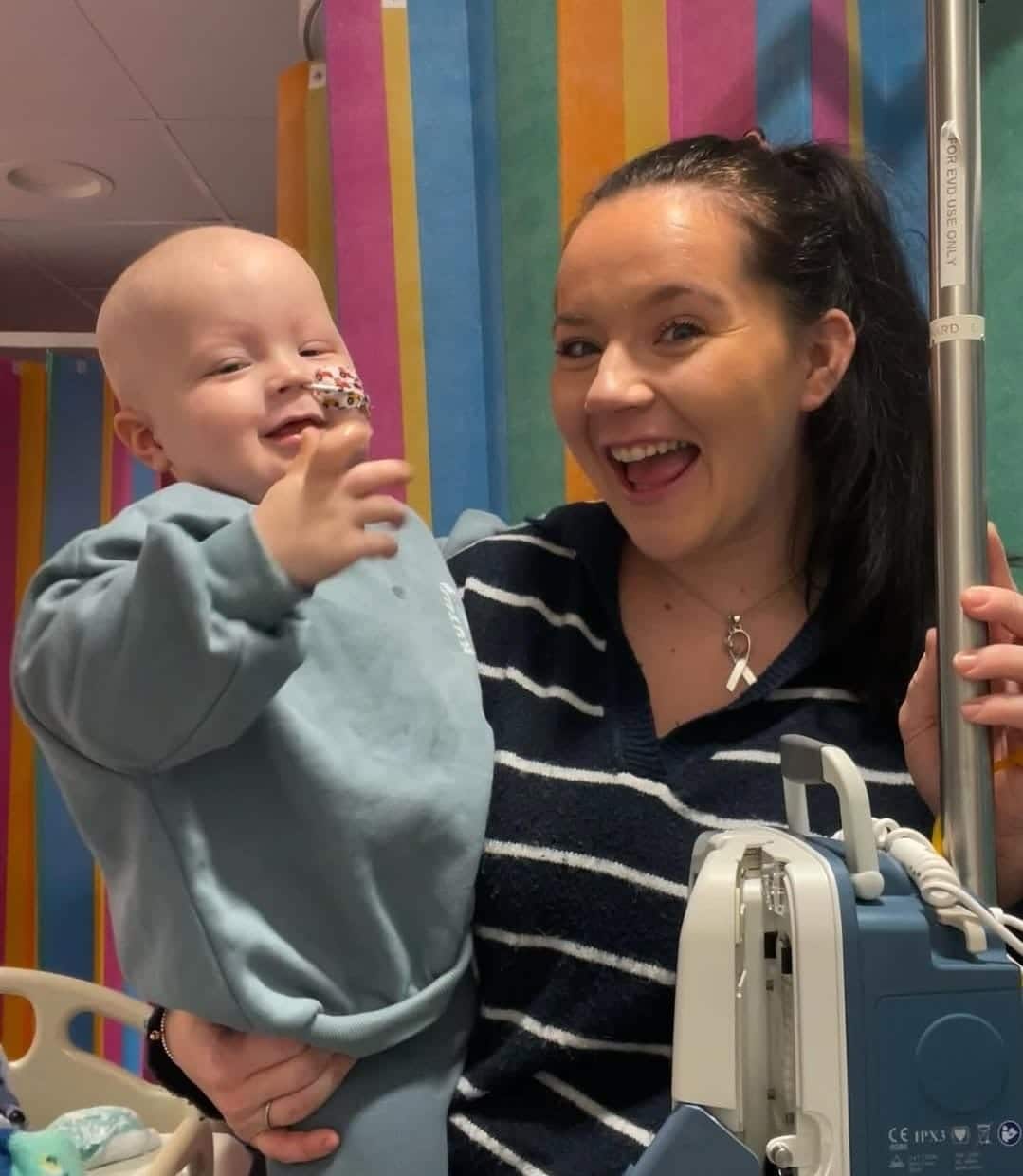
His mum, Holly, tells his story.
First worries
Leaving the house one day to go to the park, George stood on the door step and froze. I scooped him up and ran to my neighbour’s to pick something up and George was sick everywhere as she opened the door.
I put this down to the fact that George hadn’t stop eating that morning and me rushing him out the house maybe cause him to be sick. I didn’t think anything was wrong, never mind a brain tumour. But this sort of thing kept happening.
I took George to the GP who told me George was being sick, because his throat was full of mucus due to a chest infection. We were prescribed 5 days of antibiotics, but I returned to the GP as things hadn’t got any better.
The GP told me they would refer George to the paediatrician and if things got any worse to take him to A & E. George was freezing several times a day now, so I went to A & E, where George had 3 of these ‘moments’ in the waiting room. Other than the freezing, George was so well and returned back to his crazy self after. When the doctor came to assess George, because he wasn’t having a momenthe was deemed to be OK. I showed the video recordings I had taken as well as a diary I had been keeping of when these happened.
George had conjunctivitis, and they passed off the freezing as his body reacting to this and it becoming a learned behaviour. “Give him Calpol,” were their instructions and we were sent away.
I remember leaving the hospital disheartened: I knew something was not right with George. He continued freezing, so I phoned the GP and requested to be seen. He had a number of moments in the waiting room in the hour we waited to be seen. They now thought that these moments could be fits and George was possibly epileptic and they would refer him to the first fit clinic. They also chased our paediatric appointment – the first time he could be seen would be five months away in October.
Our GP could see how upset I was, so recommended that I took him to our local children’s hospital if things got worse, which they did. At the hospital, they monitored George and admitted him for the night, but sent us home because George was ‘”clinically well”. They were going to schedule an outpatients EEG but we were to return if things got worse, and they did… quickly.
Just 48 hours later on the 28th May I was sat in A & E again with George, knowing that something wasn’t right. George had fallen into having seizures every 15 minutes. I recorded every seizure in my phone: what time it happened, how long, what George was doing and on the minute every 15 mins it would happen. The seizures had gone from lasting 30 seconds to 2-3 minutes. Morning came round and the doctor on duty told us to go home.
I felt so disheartened. I argued that I couldn’t even get my little boy home without seizures happening so I refused to go, and the sister nurse agreed with me.
Within 45 minutes we were on the children’s neuro ward. George had a neurologist coming to see him and he was started on anti-seizure medication. And this is where things got scary, very fast.

Emergency
The electroencephalogram (EEG) was still showing epilepsy with the signals coming from the left side of his brain. But the neurologist were trying to figure out why he was pumped so full of anti-seizure medicines for none of them to work.
George had fallen into a very long seizure at this point – way over 30 mins – and no one could get him out of it. Emergency buzzers were pressed and I was ushered out. George was taken for an urgent CT scan. When we returned back to the ward we were taken into a tiny room and we were shown on a screen the answer as to what was wrong with George.
They had found a huge mass on his brain- our world came crashing down. They told us this was causing a lot of pressure on him brain and he needed surgery and fast. We then were transferred to HDU and he had an MRI the following day. We met his surgeon who informed us the surgery was extremely risky. The placement of George’s tumour made it very difficult as it was wrapped around the main blood vessel in the left side of his brain. This controlled the right side of his body and the chances of a large stroke were extremely high.
We got told George might not be able to walk, talk or even breathe for himself if this happened, but they would try and remove everything they could with minimal damage. The surgery was risky so took days to prepare and those days leading up to it were long, standing at his bed side, recording seizures, watching medicines get pumped through him, seeing his face start to drop. We felt so lucky that George still managed to be George and show us smiles. He was only 20 months old and some how had the strength of an ox. He stole the hearts of everybody in HDU and was known as the little boy who cheered when his seizure was over. He was continuously poked and prodded and filled with medication. We just needed the surgery to happen now. Our little boy was changing in front of us.
Surgery
On the 7th June, I handed over my little boy into the hands of the most incredible team and his life, quite literally, was in their hands. Hours and hours and hours passed. We walked and walked and walked, waiting for the phone to call, sitting in HDU with his bed empty. The nurse’s shift change happened and George still was in surgery.
Around 12 hours later, the surgeon came to find us and informed us that the surgery had gone well and they had removed a huge chunk of the tumour. There had been some unavoidable damage to the blood vessel but it was still intact. They weren’t sure how George would be, but they were extremely hopeful. They informed us George was currently having an MRI to find out more detail.
More and more time passed, we still hadn’t been called to go and get George from recovery. It was now gone midnight and I just wanted my baby back. We were told we could finally go down to theatre recovery and see him. I’m not really sure what I was expecting, but George was laid down, pure white, with his head all bandaged. He looked absolutely tiny and it was very overwhelming. I started seeing stars a little bit. The whole day had been so long, and at around 2am we had our boy back in his bed in HDU. He wasn’t awake but he was stable.
We did not know what the future held, but each day George got a little stronger. He opened his eyes, he played with the many wires he was connected too and he was sucking his dummy. These small things felt like the world to us.
Soon George wanted to try and sit up and every day he went from strength to strength- but still part of us was left in the dark. We didn’t know what this tumour was and awaited biopsy results. We didn’t know what it was that was in my baby’s head.
On the 16th June, we met George’s oncologist. I was so naive looking back, I didn’t even know what an oncologist was, what they dealt with and what they did. We had met her a few times before and she had given us information on broviac lines and brain tumours but I did not for one minute expect to be thrown into the world that we were.
We were informed that George had brain cancer- his tumour was in fact an atypical teratoid Rhabdoid tumour, otherwise known as ATRT. It was extremely rare and difficult to treat but they had a plan and they were going to do their absolutely best. They told us that in 6 days time he would be having a double lumen Broviac line fitted and spinal intrathecal chemotherapy and he would start his intense chemotherapy the day after. This meeting was very overwhelming and we met a couple of days later when everything had sunk in to discuss it in more details and this second meeting we were very grateful for as it gave a us time to let this life-changing information sink in. On the 20th June we were allowed to go home, the first time in 3 weeks, but what a 3 weeks it was. It felt we had been in hospital for months!
We returned to hospital on the 22nd June for a theatre trip for Broviac lines fitted, a lumbar puncture and his first lot of spinal chemo- followed by round 1 of his intense chemotherapy. George has had 9 intense rounds of chemotherapy consisting of 7 types of chemotherapy. He had fortnightly chemotherapy into his spine and cerebro-spinal fluid (CSF) and he has also had 30 doses of radiotherapy – which we had to move to a different city to receive!
Latest news
Nine months later, George has finished treatment and his tumour is stable. He is running round, he doesn’t stop talking and he is living his best two-year-old life. This journey has been absolutely terrifying and is far from over but we have honestly had the best team looking after George, supporting him and always doing the best for him. We have met some of the best friends on this oncology journey and count our blessings every single day for the amazing little boy that we have!
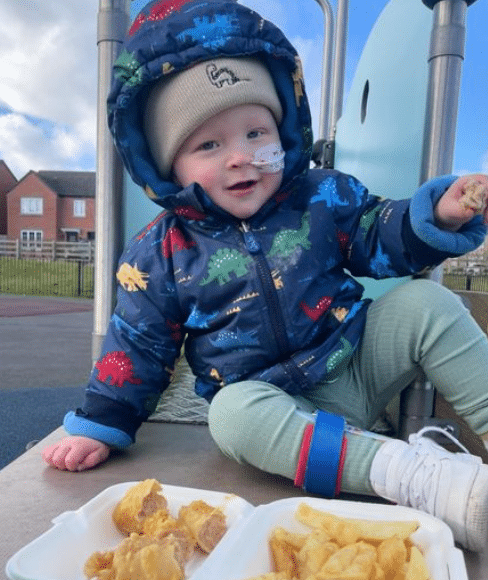
Follow @georges_atrt_journey on Instagram to find out more about this special little boy and enjoy seeing one of the happiest smiles you will ever come across in your life.